

Hey friend, it’s been a while. Hope you’re well and thanks for subscribing to the Semitechnicals newsletter!
I’ve been thinking a lot – about my relationship with technology, what it means to be a semitechnical, and how AI is changing the way people conduct themselves at work.
It’s taken some time for me to adjust to this new reality in which it’s becoming increasingly common for people to default to using AI when starting to work on a word artifact – docs, memos, articles, social posts, and even internal messages.
I too have used AI for all of the above tasks and have found that in cases where the stakes are low, letting AI do the thinking for me frees me up to continue thinking about the things I do want to think about.
The problem I run into is this:
Most times, I tend to care a little too much
I’ve always cared about what I create.
Whether it’s a work artifact, a newsletter post, or even a weekly update sent in a Slack channel. And this habit dates back to 1997 (I was eight).
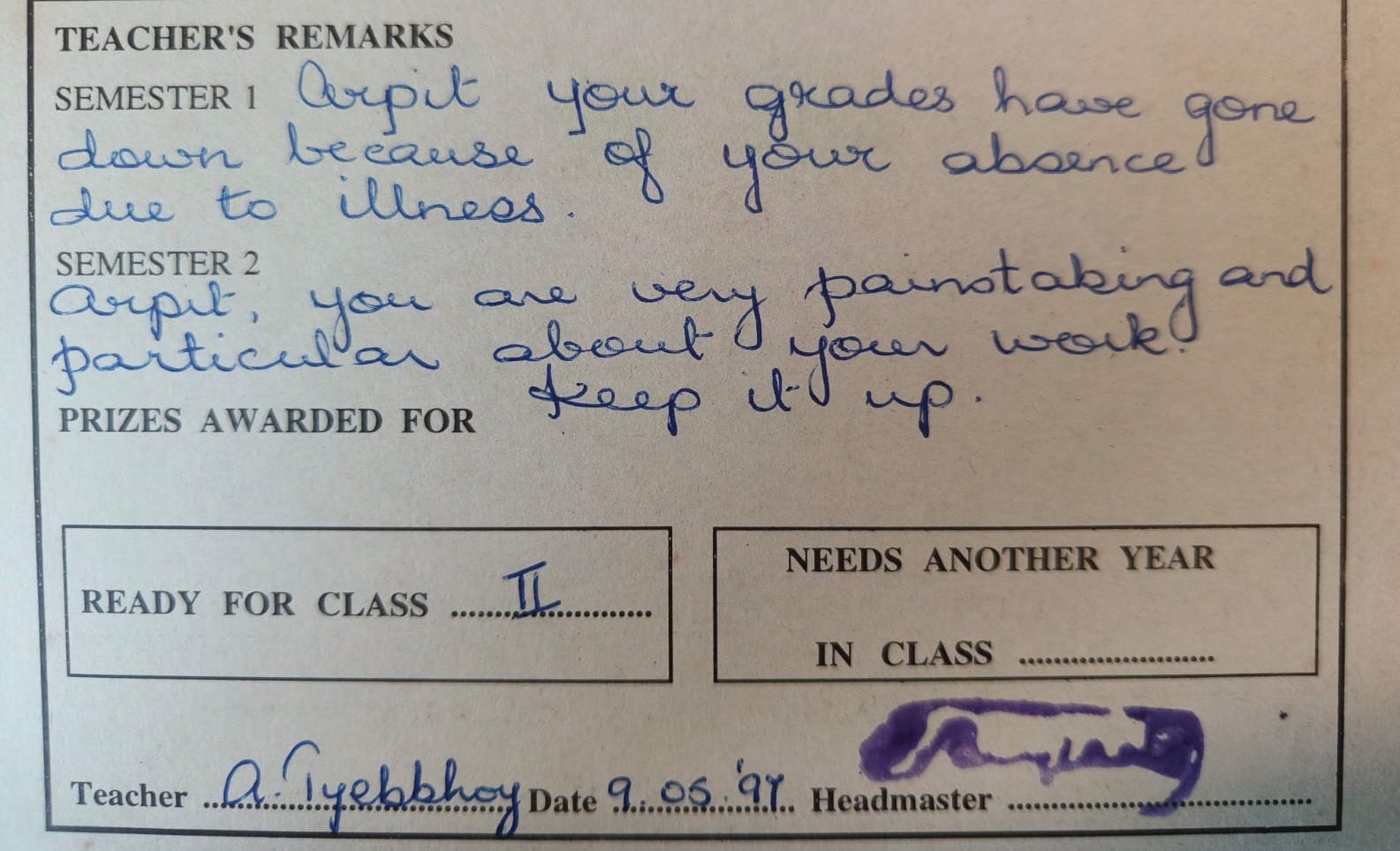
Funny that I happened to sift through my primary school report cards and came across this one where my first-grade teacher wrote, “Arpit, you are very painstaking and particular about your work. Keep it up.”
It’s starting to all make sense now.
I’ve always been particular about what I create, and have paid the price for my obsession. Starting middle school, I could never finish my examination papers because I had to make every word sound good and every diagram look great.
I distinctly remember that I’d be on page 2 of 4 of my answer sheet while my peers would already walk up to grab an extra sheet. They could go on spilling words without the need to pause and think. And it served them well because many teachers graded based on volume rather than quality.
I did alright though. I was always told that I needed to work faster but I struggled with that. Below, my fourth-grade teacher writes, “Carry on with your good work Arpit but try to increase your speed a bit.”
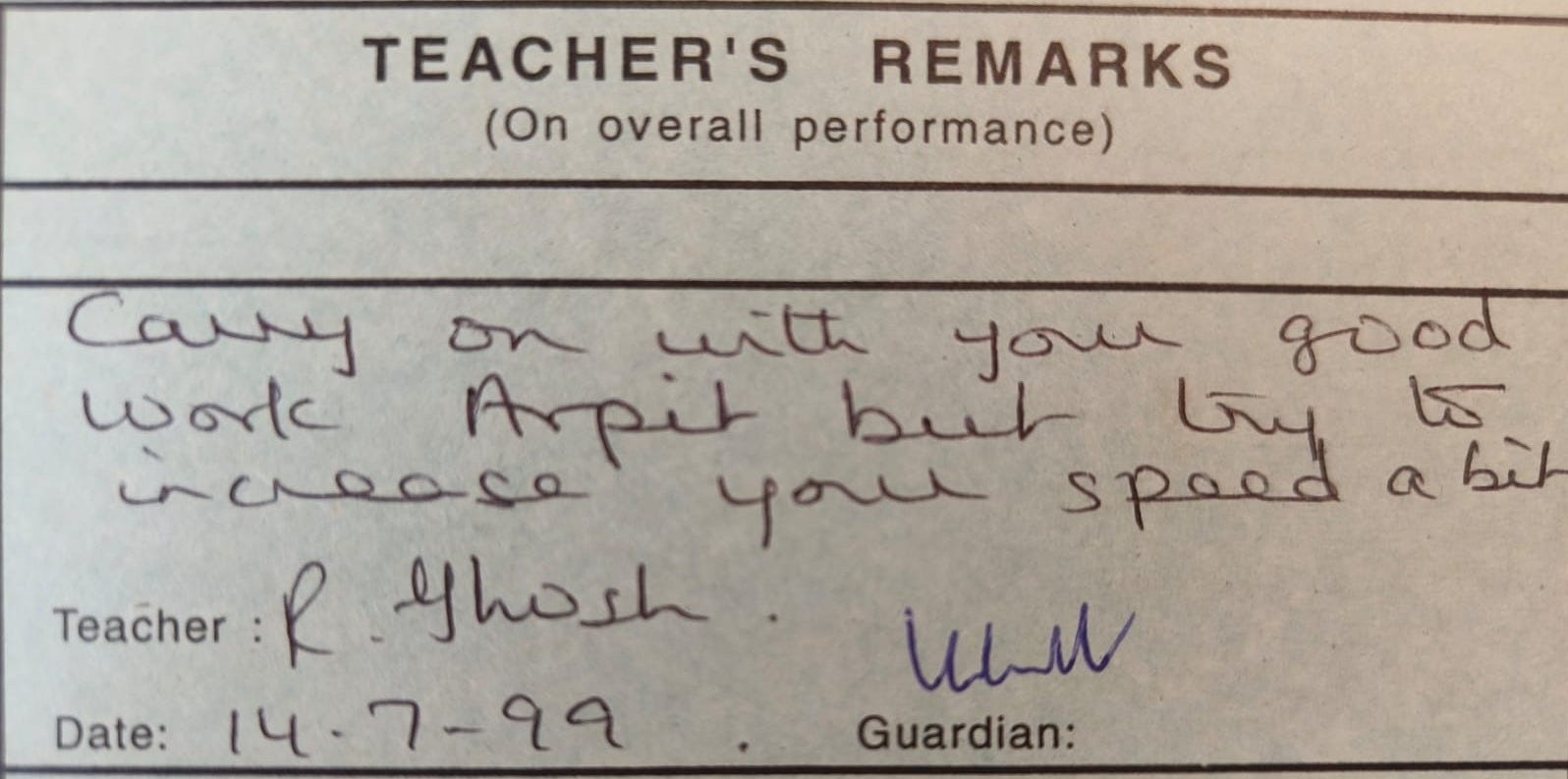
I stuck to the notion that it’s better to do less but do a good job. And doing a good job takes time because one has to think things through.
Eventually, you get faster at the things you become really good at, and that’s how you stay ahead. But speed alone is not enough. What you create has to be worth consuming – you want people to keep coming back for more.
Rethinking my technology use
I’m in the camp that believes AI will completely change how people use software – both B2B tools and consumer apps. We will increasingly talk to our machines and spend less time interacting with pixels.
But what won’t change is the need to create and consume word artifacts at work – from internal memos and messages to external posts and positioning. And what separates the average, good, and great is the time spent in thinking mode.
As more people default to AI-generated artifacts for pretty much everything, the real value will be created in organic artifacts – ones involving humans spending time doing the thinking.
Thinking horizontally
When embarking on any new project of consequence, I like to spend time thinking horizontally – lying down, tapping into lived experiences and accumulated knowledge.
Once I have generated a thesis or a set of ideas, I might run them by AI to identify blind spots or find similar ideas. This step is useful, but it’s also easy to get carried away; practicing restraint and challenging the AI’s output helps.
Before AI, I’d find myself reading through lots of sources, ingesting a lot of information, and building upon my own ideas. I think there’s value in this organic transformation of information and I’m not giving up on it – quite the contrary, in fact.
There’s immense value in spending time in organic thinking mode before consulting AI. Depending on how fast your brain is able to process information, you might end up spending hours, days, or weeks. But that mental exercise is tremendously valuable because that’s where original ideas emerge.
The context that lives within our brains cannot be replicated inside a machine (yet) and therefore, defaulting to AI right at the start can never lead to the same outcome.
What it means to be a semitechnical
I’ve been spending an inordinate amount of time thinking about this. Because being semitechnical is not being halfway between non-technical and technical. It’s not just about building without code. And it’s certainly not about learning how to use a tool or two.
I think of it less as a skillset and more as a mindset that molds one’s identity.
Of course you need some technical skills to operate some tools – just like in any job. However, what sets knowledge work apart is that one’s output is a clear reflection of one’s thinking.
It’s becoming increasingly easy to spot when the thinking is outsourced to the thinking mode inside ChatGPT, Claude, Gemini, etc. And letting AI do the thinking is a clear reflection of how much one cares about the artifacts they create – very little, obviously.
But that’s not it.
When one chooses to let AI create artifacts, they also choose to care less about the experience of the people consuming those artifacts.
And if they choose not to care much about people’s experience consuming their work, they are unlikely to care much about the work itself, let alone take pride in it.
And one not taking pride in their work leads to mediocrity.
Finally, in the age of AI – the epitome of mediocrity – there will be no place for humans creating mediocre work.
Staying ahead
The obvious answer is to shun mediocrity and set a high bar for yourself. Nobody else can do that for you, and unfortunately, most managers will expect you to be part of their performance theatre rather than push you towards excellence.
People say they want to work with people smarter than them, but when they find themselves in that situation, most cannot handle it. Humans have evolved into control-seeking animals and independently-minded people are perceived as threats by most. And those who settle for mediocrity are the easiest to control because they are the easiest to replace.
On the contrary, those who consistently produce top-notch work – not because it’s expected but because they choose not to settle for anything less – are always at an advantage.
But the question remains: How do you pursue excellence when surrounded by mediocrity?
Well, once you set a high bar for yourself, you can tap into your intrinsic motivation – one that doesn’t rely on external validation. You need to decide what good looks like and work towards greatness – you will know once you get there.
Most people only talk about it but very few experience it because getting there takes years of effort (plus a healthy dose of good luck).
The Semitechnical Cake
In my quest to get more people to understand what it really means to be a semitechnical and identify as one, I’ve come up with this visual model called The Semitechnical Cake:
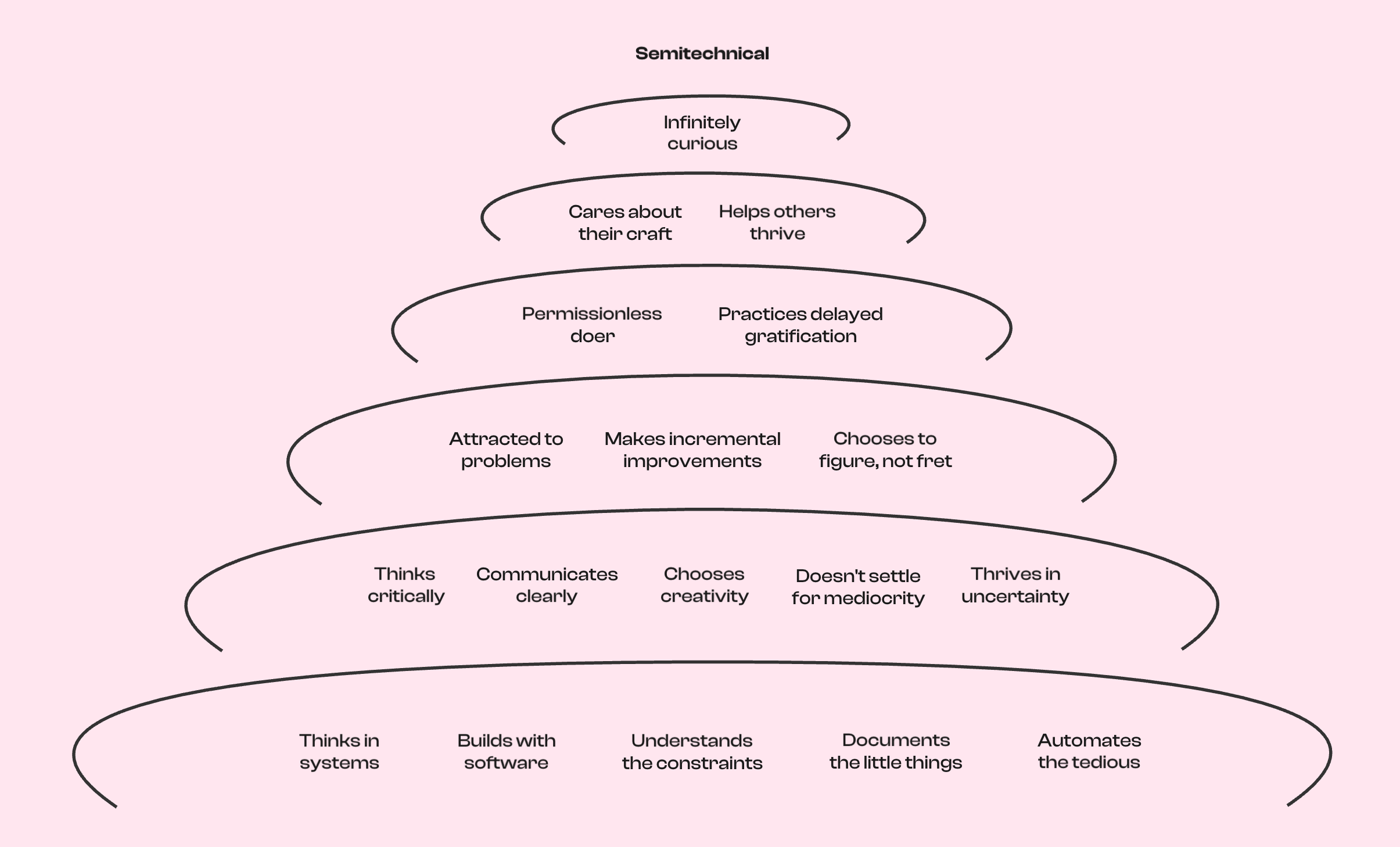
The model depicts the 18 core traits of a semitechnical. The bottom layer lays down the “technical skills” that need to be learned – everything else is an attitude, part of one’s mindset.
As you can probably tell, I think about this stuff a little too much and it’s taken several iterations to arrive at this model. There’s very little overlap between the traits; you start at the bottom and work your way up the layers, adopting the attitudes one by one.
You might be nodding and saying to yourself, “Well, I already possess these traits”, to which I’d say, “Well then, my friend, you’re already a semitechnical and you must stop calling yourself non-technical.”
Hear me out
You're better off spending your limited time and mental capacity learning the basics of any given piece of technology that you intend to use every day – instead of every other tool built on the same foundations.
Loved reading this..especially the references to your academic records. :) It is impressive to see how your attention to detail has remained a consistent hallmark of your work throughout your career.
This was an insightful read! Completely agree with you, humans need time to think deeply. Otherwise you end up creating surface level connections.
You'd think will all the tools we adopt to speed things up in our lives we'd get more time to do that deep thinking but somehow it keeps a lot of us stuck at the surface struggling to connect (myself included at times).