
The Technicality Spectrum
Not a barbell

The spectrum was updated on December 30, 2025.
It’s funny how sometimes you start doing something you really want to, but then get presented with an opportunity that would be silly to pass on, only to find yourself years later wanting to go back to that thing you left incomplete.
And when you finally do go back to that thing, it feels as though a part of you has been waiting all along for the other parts to come back from the detour, so that you can get going towards the final destination.
Back in 2019, when I was leading growth at Make (then Integromat), the no-code trend was in full swing. And yes, it was a trend and not a “movement” as some liked to call it.
My biggest point of annoyance was that instead of helping newcomers acquire foundational knowledge about software development, data, and automation, individuals with large audiences in our space only cared about pushing tools they were affiliated with. They made their bucks and moved on to the next hot trend – rinse and repeat.
The same thing is happening today.
Too much focus on learning specific tools rather than learning the underlying technologies.
“Experts” are pushing the same false narrative: learn this tool – and not that one – if you want to do this work.
People who are new to the space, looking to acquire monetizable skills to stay relevant in this mad economy, are overwhelmed. They are spending their limited capacity deciding which tool to learn and jumping from one to the other based on recommendations from anonymous gurus on Reddit.
The part of me that was left behind is finally reunited with the other parts, and together with their combined knowledge, are now headed to the final destination – a place for all of us semitechnicals.
We’re not “non-technical”
Crazy how even in 2025, people like you and me are often labelled “non-technical” because we’re not code-writing engineers.
Well, I refuse to accept that label and so should you – especially if the following sound like you:
Thinks in systems
Builds with software
Understands the constraints
Documents the little things
Automates the tedious
Thinks critically
Communicates clearly
Chooses creativity
Doesn’t settle for mediocrity
Thrives in uncertainty
Attracted to problems
Makes incremental improvements
Chooses to figure, not fret
Permissionless doer
Helps others thrive
Cares about their craft
Practices Delayed Gratification
Infinitely curious
Sounds like you?
Then for god’s sake, stop calling yourself “non-technical”. Where you live on the technicality spectrum is for you to decide, but keep in mind that your position isn’t static – you’re moving every day. And not necessarily to the right → but also to the ← left.
There are days when I spend hours making diagrams in Miro, playing around with every little element (and bugging my wife to help me decide between variants that often look the same to her).
What you see below is an outcome of me going through this process – one that I won’t give up for the sake of moving faster:
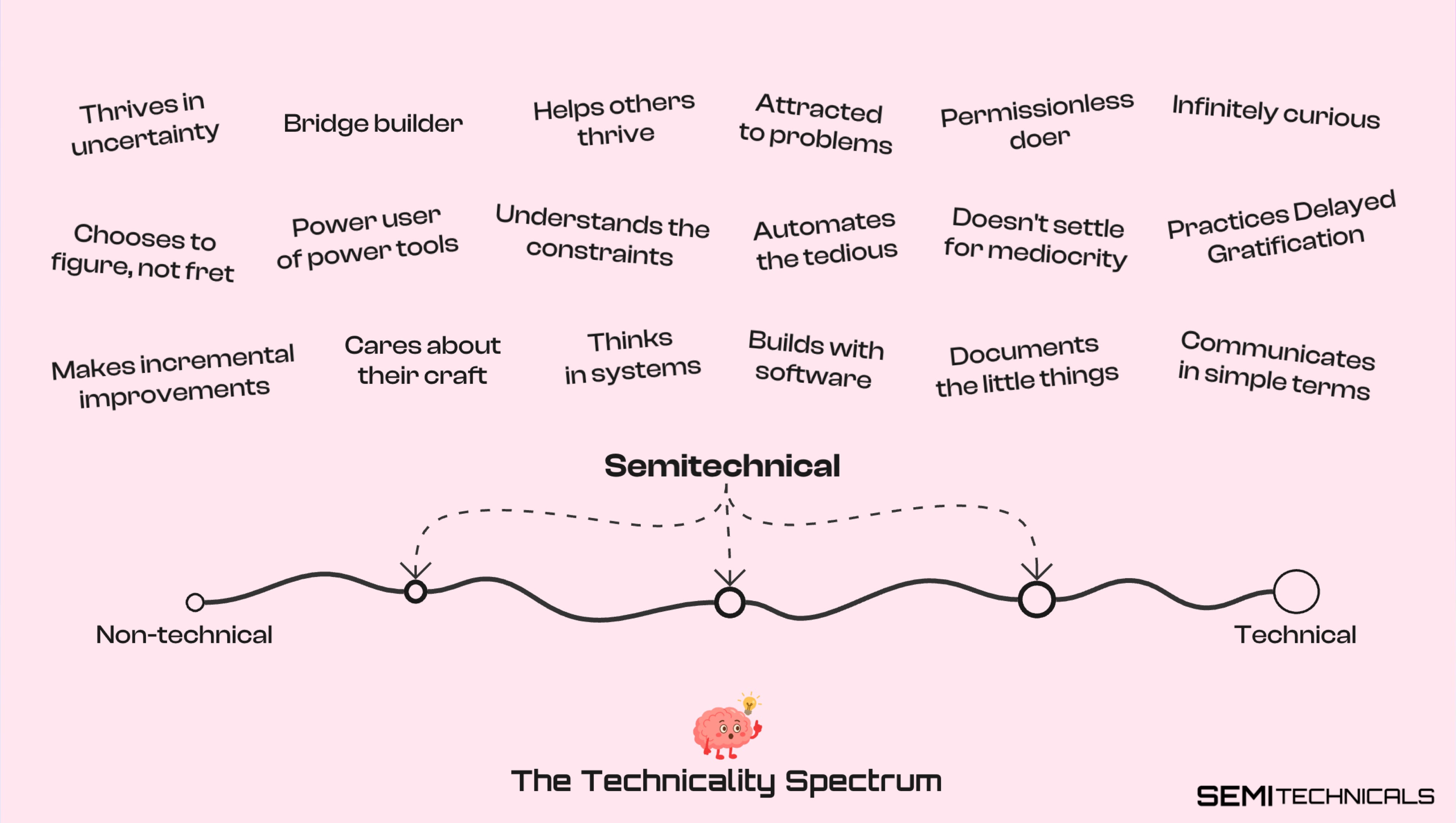
The primary idea behind the technicality spectrum is that you don’t need to hit a milestone to call yourself a semitechnical. Similarly, even if you already have technical skills in a particular domain, you can identify as a semitechnical in an adjacent one.
In fact, the more I think about it, the more I’m convinced that the world already has more semitechnicals than non-technicals.
If you’ve ever seen a live movie set, you’ll know what I’m getting at.
The people operating those insane cameras or the people obsessing over lighting positions are super technical people, aren’t they? But the moment they step out of the movie business, they are labelled “non-technical” lol.
I’m convinced that this is true of every industry, and not just tech:
The very-technicals tend to think less of the less-technicals, even when the same people might be way more technical than the very-technicals in an adjacent context.
Think about this:
Who is more technical? The engineer building AI tools to generate videos or the filmmaker who is tinkering with those tools to create something worth watching?
Engineers thinking of users of their software as non-technical is not very different from a luthier (instrument maker) thinking the same of a rock star. Imagine Orville Gibson, the inventor of the Gibson guitar, thinking “less” of Jimi Hendrix. Crazy right?
So, the next time you see someone use the term “non-technical”, let them know about the technicality spectrum and help them understand what it means to be a semitechnical!
Happy Holidays! 🎅
Before you go, you gotta check out this video by my friend William, who’s helped me understand that being a <semi> can mean so much more!
Lead me to my final destination Lisan al-Gaib 🙇🏽♂️
Love your writing!